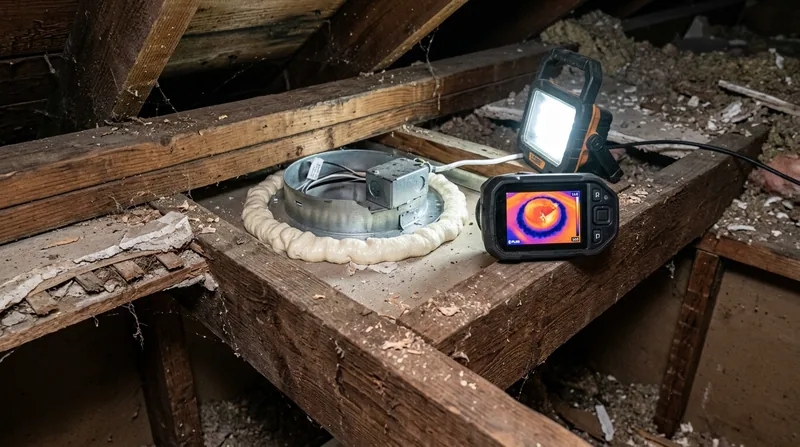




Air sealing in St. Cloud stops the constant leak of conditioned air through gaps, cracks, and unsealed cavities that plague homes built on the Mississippi River bluffs and in the surrounding farm country of Stearns and Benton County. St. Cloud winters drop below 25 degrees for weeks at a time, and the temperature swing between a heated attic in July (130 degrees Fahrenheit) and a frozen one in January creates a relentless vapor drive that pushes outward through every unsealed rim joist, band joist, and balloon-framed wall cavity. The frame homes of Pantown and the Northside, the 1950s and 1970s ramblers scattered across the East Side and Waite Park, and the newer two-story builds in Sartell and St. Joseph all share the same problem: air leaks that cost money and make rooms cold. Air sealing with spray foam closes those leaks permanently, stops ice dams before they start, and works in tandem with proper attic insulation to hold heat in winter and cool air in summer. We have been doing this work in St. Cloud since 2012, and we know exactly where the leaks are in your house.
Why Air Sealing Matters in St. Cloud's Extreme Climate
St. Cloud sits at the threshold of two climates: the agricultural interior of Minnesota and the glacial lake country to the north. Winter cold is relentless, and the temperature differential between inside and outside creates a pressure that pushes warm, moist air through every unsealed gap in the building envelope. Attics and rim joists are the worst offenders. A single 1/8-inch crack running the length of a rim board can leak as much conditioned air as leaving a window cracked open all winter. Ice dams form when warm air rises through an unsealed attic, melts the snow on the roof, and the water refreezes at the eave. Air sealing stops that cycle at the source. It also prevents the musty, cold feeling in basement rim joists and crawl spaces that plague 1950s and 1960s ramblers all across the East Side and Waite Park.
- We seal rim joists and band joists where the house sits on the basement wall, stopping air infiltration at the thermal boundary.
- We seal the attic floor and all penetrations (electrical, plumbing, HVAC) so conditioned air stays inside the living space.
- We seal walls and cavities in older balloon-frame homes where the interior cavity runs from basement to attic unbroken.
- We seal garage walls and ceilings so the unheated garage does not pull heat from the home.
- We seal crawl spaces and rim areas in lake homes and seasonal properties that are being converted to year-round use.
Proper air sealing is the foundation of any insulation retrofit, and it is the single biggest differentiator between a home that holds its conditioning and one that does not.
Key info: St. Cloud's vapor drive pushes outward most of the year due to the long cold season and the moisture load inside heated homes. Air sealing with spray foam is a vapor barrier and an air barrier at the same time, which is why it works where fiberglass batts alone do not.
For more detail on how insulation and air sealing work together, see our attic spray foam insulation page.
How We Perform Air Sealing in St. Cloud Homes
Air sealing is a methodical process that begins with a careful walk-through of the house. We identify every gap, crack, and unsealed penetration that is leaking air. In St. Cloud, the most common problem areas are the rim joist (where the house meets the basement wall), the attic floor (especially around electrical boxes and HVAC penetrations), and the band joist in older frame homes. We then apply closed-cell or open-cell spray foam to seal those gaps permanently. The foam expands to fill the cavity, adheres to the substrate, and cures to form both an air barrier and a moisture barrier. We work methodically, layer by layer, to the thickness and density specified in our written estimate.
- We inspect the substrate and ensure it is clean, dry, and ready to accept foam.
- We set up mechanical ventilation during application and cure to control odor and off-gassing.
- We apply foam in controlled passes, respecting the manufacturer's ratio and drum temperature.
- We document thickness and R-value on site and provide a written record with your estimate.
- We observe a 24 to 48-hour re-entry window before you return to the space.
- We advise on any permits or thermal barrier requirements that apply to your address.
The result is a home that holds its conditioning, stays warmer in winter, cooler in summer, and stops the ice dam cycle before it starts.
Example: A 1960s rambler in Sauk Rapids with an open rim joist and a balloon-framed wall cavity loses air constantly. We seal the rim joist with 2 inches of closed-cell foam (R-12 to R-14), then inject foam into the wall cavity from the basement without tearing out drywall. The homeowner sees warmer rooms, no more cold spots, and ice dams stop forming. Total cost, on estimate.
For details on how our work fits into a larger insulation retrofit, visit our insulation replacement and re-insulation page.
Air Sealing Methods and When to Use Each
| Approach | Description | Best for |
|---|---|---|
| Closed-Cell Spray Foam Air Sealing | High-density foam (1.5 to 2 lbs per cubic foot) applied in thin layers. Forms a rigid, moisture-resistant barrier. R-value is 6 to 7 per inch. | Rim joists, band joists, crawl spaces, and any air leak in a wet or damp location. St. Cloud's vapor drive makes this the standard choice for basement rim work. |
| Open-Cell Spray Foam Air Sealing | Low-density foam (0.5 to 0.7 lbs per cubic foot) that is softer and more flexible. R-value is 3.5 to 4 per inch. Allows vapor diffusion. | Interior attic rim work, wall cavities, and garage ceilings where moisture is not a concern. Lower cost per board foot than closed-cell. |
| Injection Foam (Wall Cavities) | Closed-cell foam injected into existing wall cavities from the basement or crawl space without removing drywall. Fills balloon-frame voids completely. | Pre-1980 frame homes in Pantown, the Northside, and the Southside with empty wall cavities. Retrofit without demolition. |
| Attic Rim and Perimeter Sealing | Foam applied to the rim joist, band board, and top of the rim wall where the attic meets the exterior wall. Seals the biggest air leak path. | Every home in St. Cloud, Sartell, Waite Park, and the surrounding area. This is the single most cost-effective air sealing job. |
Air Sealing Cost in St. Cloud: What to Expect
Air sealing costs depend on the size of the area, the type of foam, the substrate condition, and the complexity of the penetrations. A rim joist seal on a 1,500-square-foot rambler in Waite Park or St. Joseph typically starts at $650 to $1,200, depending on whether you are sealing one rim or wrapping the entire perimeter. A full attic rim and penetration seal on a two-story home in Sartell or the East Side can run $1,500 to $2,500. Wall cavity injection in an older Pantown or Northside frame home is priced per board foot on site and usually falls in the $800 to $2,000 range for a single wall or a stairwell cavity.
The biggest cost drivers are access (finished basements, tight crawl spaces, and high attics cost more to work in), the amount of prep work needed (wet basements or contaminated rim joists must be dried or cleaned first), and the scope (a single rim joist is cheaper than a full perimeter seal). We always provide a written estimate with R-value and thickness specifications before we begin. There are no surprises, and you can compare our estimate with others side by side.
For a detailed breakdown of pricing across all our services, visit our pricing page. To get a free, no-obligation estimate for your home, call us at (320) 433-8205 or visit our contact page.
Air Sealing Near Me: What St. Cloud Homeowners Should Know When Hiring
Air sealing is a straightforward service, but the quality of the work depends entirely on the installer's knowledge of the local building code, the substrate, and the correct foam application technique. When you are looking for an air sealing contractor in St. Cloud, Sartell, Sauk Rapids, or Waite Park, ask the right questions. First, request a written estimate that includes the R-value and thickness of the foam, not just a board-foot price. Second, ask whether the contractor will provide mechanical ventilation during cure and specify a re-entry window. Third, verify that the contractor carries full insurance and can provide a certificate on request. Fourth, ask about permits. Air sealing itself rarely requires a permit in St. Cloud, but if the work involves disturbing existing insulation or modifying the attic ventilation, your local building department may have rules. We help you navigate what applies to your address.
- Get at least two estimates from contractors you can reach by phone and who will answer questions after the job is done.
- Check references from recent jobs in St. Cloud, Waite Park, or Sartell, and call them to ask about odor, cleanup, and follow-up.
- Avoid contractors who promise immediate re-entry, offer a price far below market with no inspection, or cannot explain what R-value or thickness they will install.
- Ask whether the contractor removes old insulation before sealing, or seals over it. Sealing over old, wet, or contaminated insulation is a red flag.
- Confirm that the contractor is fully insured and that the policy covers spray foam application and curing.
We have been in St. Cloud since 2012, and we stand behind every job. If you have questions about air sealing or want a free estimate, call (320) 433-8205 or contact us online.
For more on how closed-cell foam performs in St. Cloud's climate, see our closed-cell spray foam page.
Air Sealing in St. Cloud: Pricing Guide
| Service | Price | Details |
|---|---|---|
| Rim joist and band joist sealing | Starting at $650 | Perimeter length, access difficulty, and whether the rim is open or partially buried determine final cost |
| Full attic rim and penetration sealing | Starting at $1,200 | Attic size, number of penetrations (electrical, plumbing, HVAC), and substrate condition affect the final price |
| Wall cavity injection (balloon-frame retrofit) | Starting at $800 | Priced per board foot on site, depending on cavity depth, width, and length, plus access method and substrate |
| Crawl space rim and perimeter sealing | Starting at $900 | Size of crawl space, headroom, moisture condition, and whether existing insulation must be removed first |
| Complex or multi-area sealing job | On estimate | Combination of rim, attic, wall, and garage work requires on-site assessment to provide accurate board-foot and labor pricing |
| Free estimate | No obligation | Response within 24 hours at (320) 433-8205, includes written quote with R-value and thickness specifications |
Indicative pricing, the exact cost depends on square footage, finish, and site access. Free personalized estimate within 24h at (320) 433-8205.


