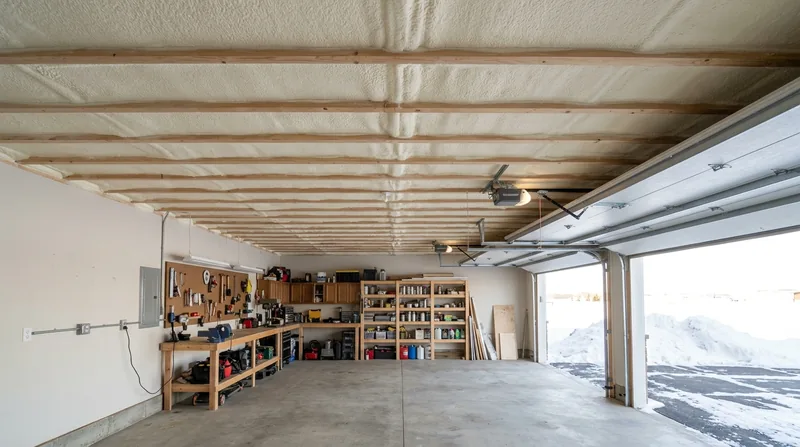




Garage spray foam insulation in St. Cloud transforms an uninsulated or poorly insulated garage into a climate-controlled space that stays warm in winter and cool in summer, while cutting the heating and cooling load on your home. St. Cloud's winters drop below 25 degrees for months at a time, and most garages built before the 1990s were never insulated at all. A heated three-car garage attached to your home is a direct thermal bridge to the basement and first floor unless you seal and insulate the rim joist, band joist, and the garage ceiling or walls. Spray foam closes air leaks that fiberglass batts and blown-in insulation miss, and it holds its R-value year after year without settling or moisture damage. Whether you use your garage as a workshop, a mudroom, or a place to park in January without freezing your fingers, the right insulation approach starts with understanding your building and your goals.
Why Garage Insulation Matters in St. Cloud's Climate
An uninsulated garage wall or ceiling is a constant drain on your heating system. Cold air from the garage seeps into living spaces through rim joists, band joists, and any door or wall that separates the garage from the house. In St. Cloud, where the Mississippi River valley carries winter temperatures down to 25 below zero and stays there for weeks, that thermal loss adds up fast. A spray foam insulation job on your garage ceiling, walls, or rim joist stops that leakage and creates a thermal barrier that actually works year-round.
- Spray foam seals cracks and gaps that fiberglass batts cannot reach, stopping air infiltration at the source.
- Closed cell foam provides high R-value in a thin layer, ideal for garage ceilings with limited depth.
- Open cell foam costs less and works well for garages that do not need vapor resistance, such as unheated or intermittently heated spaces.
- Foam does not settle, compress, or lose effectiveness over decades the way loose-fill and batts do.
- An insulated garage ceiling reduces the heating load on the rooms above, lowering your monthly utility bill.
Choosing the right insulation type and thickness depends on whether your garage is heated, how it is used, and whether it shares a wall or ceiling with your home.
Key info: Most St. Cloud homeowners in Sartell, Waite Park, and the Eastside neighborhoods have three-car garages built after 1990 with heated floors and attached to the house. These garages need rim joist and band joist insulation plus a sealed ceiling to prevent warm air from rising into the attic and melting snow on the roof, which causes ice dams in January and February.
Learn more about how spray foam works in other parts of your home by reading about attic spray foam insulation and rim joist and band joist spray foam.
How We Spray Foam Your Garage: The Process in St. Cloud
Garage spray foam starts with a site visit to measure the space, identify air leaks, check for moisture or existing damage, and understand how the garage is used. We then explain whether closed cell or open cell foam makes sense for your situation, what thickness we recommend, and what the job will cost. Once you approve the estimate, we schedule the work, prepare the space, apply the foam in controlled passes to the specified thickness, and let it cure before you return to normal use.
- We visit your garage, measure the ceiling or walls, and assess the substrate for moisture, damage, or contamination.
- We recommend open cell or closed cell foam based on your garage type, local code, and your goals for the space.
- We quote the job by board foot, R-value, and thickness, with written specifications on the estimate.
- We set up mechanical ventilation and prepare the work area to protect your belongings and the surrounding home.
- We apply the foam in multiple thin passes to achieve the exact thickness and density specified, never rushing or spraying thick single passes.
- We allow the foam to cure for 24 to 48 hours before you re-enter the space or park your vehicles.
The entire process, from estimate to finished cured foam, typically takes one to two weeks in St. Cloud, depending on weather and scheduling.
Example: A homeowner in St. Joseph with a 400-square-foot heated garage ceiling had us spray 2 inches of closed cell foam at R-13 to stop heat loss into the attic. We removed old fiberglass batts first, sealed the rim joist with foam, and applied the new foam in two passes over one day. The garage stayed at 65 degrees that winter instead of 45, and the heating bill for the main house dropped noticeably in February and March.
For more information on how we prepare and execute insulation work, see our air sealing service, which pairs with garage foam to close every thermal leak in your home.
Garage Spray Foam Methods and Materials
| Approach | Description | Best for |
|---|---|---|
| Closed Cell Spray Foam | High-density foam with R-6.5 per inch, closed cells block vapor and air, rigid when cured, requires thermal or ignition barrier per code. | Heated garages, attached garages, rim and band joists, condensation control in cold climates. |
| Open Cell Spray Foam | Lower-density foam with R-3.6 per inch, open cells allow vapor to pass, soft and flexible when cured, requires thermal barrier per code. | Unheated or intermittently heated garages, sound dampening, cost-sensitive projects, detached garages. |
| Rim and Band Joist Foam | Spray foam applied to the band joist and rim board where the garage wall meets the foundation, seals the thermal bridge between garage and basement. | All attached garages, especially in St. Cloud where basements are heated and rim joists are exposed to outdoor air. |
| Garage Ceiling Foam | Spray foam applied to the underside of the roof deck or attic floor above the garage, creating a sealed thermal boundary. | Heated garages attached to the home, preventing warm air from rising into the attic and causing ice dams. |
| Garage Wall Foam | Spray foam applied to the interior or exterior face of garage walls, fills cavities and seals air leaks in one application. | Older garages with empty stud cavities, workshops and heated spaces, metal-frame garages and pole buildings. |
Garage Spray Foam Insulation Cost in St. Cloud: What to Expect
Garage spray foam insulation in St. Cloud starts at around $1,200 for a basic ceiling or rim joist job and rises based on the square footage, the type of foam, the thickness you need, and whether existing insulation must be removed first. A 400-square-foot garage ceiling with 2 inches of closed cell foam typically runs $1,500 to $2,200. Rim joist and band joist work on a 30-by-40-foot garage runs $800 to $1,400. A full garage with ceiling, walls, and rim joist work can reach $4,000 to $6,000 depending on the space and the foam type.
The main factors that move the price are:
- Square footage of the area to be sprayed (ceiling, walls, or rim joists).
- Thickness and R-value you need for your climate and code (typically 2 to 4 inches in St. Cloud).
- Type of foam: closed cell costs more per board foot but delivers higher R-value in less space.
- Whether we remove old insulation, drywall, or other materials before spraying new foam.
- Access and substrate condition: wet, contaminated, or damaged areas require remediation or removal before foam can go on.
Every estimate is written with R-value, thickness, and board-foot quantity so you can compare apples to apples with other contractors. We recommend getting two or three estimates before you decide, and always verify that each quote specifies the foam type, density, and thickness in writing. Visit our pricing page for a detailed breakdown of what drives cost and what is included at each tier.
Garage Spray Foam Insulation Near Me: What St. Cloud Homeowners Should Know When Hiring
Hiring a spray foam contractor is a decision that affects your home's comfort, safety, and resale value. The contractor you choose should be fully insured, able to provide references from recent jobs in St. Cloud or nearby towns, and willing to explain their process and answer your questions before they ever spray. Permitting and code compliance vary from city to city across Greater St. Cloud, so the right contractor will help you understand what applies at your address and defer to the local building department on thermal barriers, ignition barriers, and ventilation requirements.
When you call or meet with a contractor, look for these marks of a professional operation:
- A written estimate that specifies the foam type, R-value per inch, total thickness, and total board feet.
- Clear explanation of open cell versus closed cell foam and which one makes sense for your garage.
- Willingness to discuss moisture, substrate condition, and why they will or will not spray over wet, damaged, or contaminated areas.
- Mechanical ventilation setup during spray and cure, and a stated re-entry window of 24 to 48 hours.
- Proof of full insurance coverage and a workmanship warranty of one to three years on the installation itself.
- Willingness to verify any local permits or HOA architectural approvals that may apply to your job.
- Availability for a follow-up visit or phone call if questions arise after the job is complete.
Avoid any contractor who quotes a price per square foot with no R-value or thickness, promises immediate re-entry, or cannot provide references. The spray foam trade has its share of rig-and-run crews that spray a job in an afternoon and disappear when the smell will not go away or the foam cures improperly. A local contractor with a local address and local plates, who has been in business for years and stands behind the work, is worth the phone call. Contact us for a free estimate and we will walk you through the entire process, answer every question, and help you understand what your garage needs.
Garage Spray Foam Insulation in St. Cloud: Pricing Guide
| Service | Price | Details |
|---|---|---|
| Rim Joist and Band Joist Foam | Starting at $800 | Seals the thermal bridge where garage meets basement, protects attached homes from heat loss, most common entry-point job |
| Garage Ceiling Foam | Starting at $1,200 | 2 to 3 inches of closed or open cell on 300 to 500 square feet, prevents ice dams and stops heat rise into attic |
| Full Garage Insulation | Starting at $2,800 | Ceiling, walls, and rim joist on heated garage, includes removal of old insulation and complete thermal enclosure |
| Metal Building and Pole Barn Garages | On estimate | Closed cell foam on metal skin prevents condensation drip, pricing depends on building size, height, and access difficulty |
| Travel and Site Visit | Included | No mileage fee or call-out charge in St. Cloud and surrounding service areas, estimate response within 24 hours |
| Free Estimate | No obligation | Written quote with R-value, thickness, and board feet specified, call (320) 433-8205 or request online |
Indicative pricing, the exact cost depends on square footage, finish, and site access. Free personalized estimate within 24h at (320) 433-8205.


