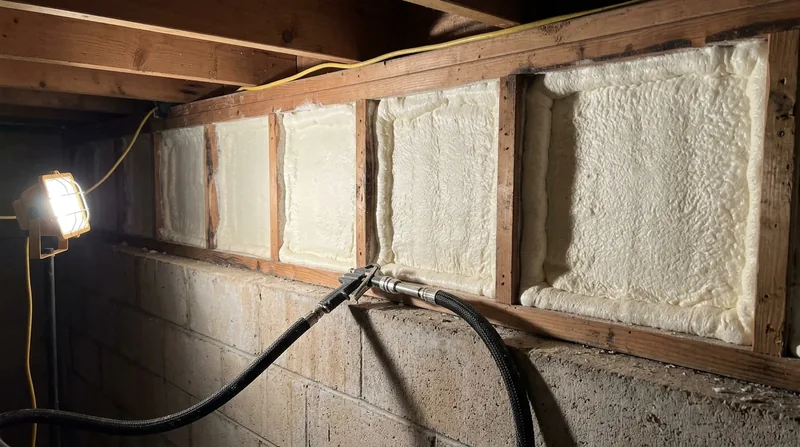




Rim joist and band joist spray foam insulation is the entry point for most St. Cloud homeowners to understand how air sealing protects a basement from the cold that drives heating costs up every winter. The rim joist is the band of wood or block that sits on top of your foundation wall, below the first floor framing, and it is almost never insulated in the older stock that lines the Southside, Northside, Pantown, and East Side. In 1950s ramblers and split-entries across Sauk Rapids, Waite Park, and Sartell, the rim is often exposed to the unheated garage or crawl space, and in newer two-story and twin-home construction from the 1990s onward, it runs beneath heated living space but still leaks. The rim joist is one of the largest thermal bridges in a basement-built home, and sealing it with closed cell spray foam stops the cold that radiates through the rim and band, cuts the load on your furnace, and pays for itself faster than almost any other insulation retrofit. We spray the rim joist in place, adhere the foam to the concrete or block, and seal every rim joist cavity, band board joint, and ledger crack in a single pass.
Why Rim Joist Sealing Matters in St. Cloud's Cold Climate
St. Cloud sits at the northern edge of the Upper Midwest, where winter temperatures drop to 25 below zero and stay there for weeks. Your basement foundation sits on frozen ground, and the rim joist that connects it to the first floor is the weakest point in the thermal envelope below grade. Cold air infiltrates through the rim, through the seams where the rim meets the band board, and through cracks in the rim where settling has opened gaps that fiberglass batts cannot seal. A rim joist without insulation loses more heat per square foot than an uninsulated attic, because the rim is in continuous contact with outside air through the rim vents that builders left open for crawl space ventilation, and because the rim is smaller in area but sits directly on the foundation where the ground pulls heat away all winter.
- Cold radiates through the rim joist into the first floor, making floors feel cold even when the furnace is running.
- Uninsulated rim joists account for 10 to 15 percent of total heat loss in a basement-built home in this climate.
- Spray foam adheres to concrete and block and fills every void, stopping air infiltration at the source instead of trying to trap it with batts.
- The rim joist is the easiest retrofit to complete in a single day, without disturbing living space or requiring attic access.
Sealing the rim joist is the fastest way to lower your heating bill and the foundation for any whole-home air sealing strategy in St. Cloud.
Key info: In St. Cloud and Sauk Rapids, the rim joist sits between the heated basement or first floor and the unheated crawl space or rim cavity. Spray foam fills that cavity completely and stops the cold air that fiberglass batts leave unsealed at the edges and joints. A typical rim joist retrofit in a St. Cloud rambler or split-entry takes 4 to 6 hours and covers 200 to 400 linear feet of rim.
For more on how air sealing works across your whole home, see our air sealing service page.
For details on the regulations that apply to rim joist work in St. Cloud, contact your local building department. Minnesota does not require state licensing for insulation contractors, and the building code that governs thermal barriers and ignition barriers is enforced by your city, not by us. Always verify your contractor's insurance and ask to see the certificate of insurance before work begins.
How We Spray the Rim Joist: Step by Step
Rim joist spray foam begins with a site visit to measure the perimeter, assess the rim cavity, and check for moisture, settling cracks, or debris that must be cleaned before we spray. We use closed cell spray foam for rim joists because closed cell has a higher R-value per inch, adheres firmly to concrete and block, and resists moisture from the foundation wall and seasonal humidity swings that are common in St. Cloud basements. The process is quick, the results are immediate, and the rim cavity stays dry and sealed for decades.
- We inspect the rim cavity from the basement or crawl space side and identify any cracks, water stains, or debris that require attention before spraying.
- We clean the rim surface with a wire brush or compressed air to remove dust and loose material so the foam bonds directly to the concrete or block.
- We spray closed cell foam into the rim cavity in thin, overlapping passes, building thickness gradually to the depth required by code and your R-value target.
- We allow the foam to cure for 24 to 48 hours before the space is re-entered, and we provide mechanical ventilation during cure to manage vapors.
- After cure, we trim excess foam flush with the rim face and seal any small gaps with caulk or additional foam as needed.
The entire job is completed from inside the basement or crawl space, with no exterior digging, no disruption to landscaping, and no access needed from the living space above.
Real example: A 1960s rambler in Waite Park with a 1,200 square foot footprint has roughly 300 linear feet of rim joist. The rim cavity is 8 to 12 inches tall, the concrete foundation wall is sound, and there are no water intrusion issues. We spray 2 inches of closed cell foam into the rim, which takes about 5 hours including setup and cure prep. The homeowner sees a measurable drop in first-floor cold spots within the first week of heating season, and the furnace cycles less often because the heat loss through the rim is sealed.
To learn more about closed cell spray foam and its R-value performance, see our detailed service page.
Rim Joist Spray Foam Methods and Approaches
| Approach | Description | Best for |
|---|---|---|
| Closed Cell Spray Foam (2 to 3 inches) | High R-value per inch, moisture resistant, excellent adhesion to concrete and block. Requires mechanical ventilation during cure. | All rim joist applications in St. Cloud. Basements with humidity, crawl spaces, and rims exposed to exterior air. |
| Closed Cell with Thermal Barrier | Closed cell foam installed with a code-compliant ignition barrier (typically gypsum board or intumescent coating) when rim is adjacent to living space. | Basements finished or to be finished. First-floor rim joists in occupied homes where building code requires a thermal barrier. |
| Rim Joist with Band Board Sealing | Foam extends into the joint where the band board meets the rim, sealing the ledger crack and the rim cavity in a single pass. | Homes with visible settling cracks, air leaks at the band board, or cold first floors above unheated crawl spaces. |
| Rim Joist Retrofit with Existing Fiberglass | We remove existing batts or loose fill from the rim cavity, clean the surface, and spray closed cell foam to achieve a complete air seal. | Older ramblers and split-entries where batts have settled or compressed, or where gaps remain around the rim perimeter. |
Each method is chosen based on the rim cavity depth, the foundation material, moisture history, and whether the rim is adjacent to living space or a crawl space. We assess these factors on site and provide a written estimate with R-value and thickness specifications before work begins.
Rim Joist and Band Joist Spray Foam Cost in St. Cloud: What to Expect
The cost of rim joist spray foam in St. Cloud ranges from around $650 for a small, straightforward rim cavity to $2,500 or more for a large home with a complex foundation, moisture issues that require remediation, or multiple rim sections that require removal of existing insulation. The single biggest factor is the linear footage of rim, which correlates directly to the square footage of your home's footprint. A 1,200 square foot rambler with a simple rectangular foundation has about 300 linear feet of rim. A 2,000 square foot two-story or an irregularly shaped lot with alcoves and offsets can run 400 to 500 linear feet. A second major factor is access: a rim joist in a finished basement or behind stored items takes longer to reach than one in an open crawl space. A third is whether we need to remove existing fiberglass batts, debris, or moisture-damaged wood before we can spray. If the rim cavity is wet or shows signs of water intrusion, we do not spray until the moisture is addressed. We fix the moisture first or we walk away.
The best way to understand the cost for your home is to request a free, no-obligation estimate. We measure your rim joist perimeter, assess the cavity, and provide a written quote with R-value and thickness specifications. Most rim joist estimates are completed within 24 hours of your call to (320) 433-8205. See our full pricing overview for additional details on how we structure estimates and what factors move the cost up or down.
Getting 2 to 3 estimates is always smart, especially if you are comparing spray foam to blown-in fiberglass or batt insulation. Ask every contractor for a written estimate that includes the R-value of the material, the thickness in inches, the linear footage being insulated, and the total price. If a contractor cannot provide those details in writing, look elsewhere. The difference between a $650 estimate and a $1,500 estimate should be explainable by the size of the rim, the existing conditions, and the method used. If the difference is large and the contractor cannot explain why, that is a red flag.
Rim Joist and Band Joist Spray Foam Near Me: What St. Cloud Homeowners Should Know Before Hiring
When you are looking for a spray foam insulation contractor to seal your rim joist in St. Cloud, Sartell, Sauk Rapids, or any of the surrounding towns, the most important steps are verifying insurance, understanding the scope of work, and checking that the contractor has a clear process for managing the job and answering questions after it is complete. Spray foam is a chemical product, and the quality of the installation depends entirely on the skill of the crew and the conditions under which the foam is sprayed. A low estimate, no written specifications, a promise of immediate re-entry, or a contractor who cannot be reached after the job are all signs that the job will not be done correctly.
- Ask for proof of insurance and verify that the policy covers spray foam insulation and that the coverage is current.
- Request a written estimate that lists the R-value, thickness, linear footage, and total price, and compare at least 2 to 3 estimates before deciding.
- Ask for references from recent rim joist or basement insulation jobs in St. Cloud or nearby towns, and call at least one reference to ask about the quality of the work and the contractor's responsiveness.
- Confirm that the contractor will provide mechanical ventilation during cure and will specify a re-entry window of 24 to 48 hours before the space is occupied.
- Ask whether permits are required for rim joist spray foam in your city and, if so, whether the contractor will help you navigate the permitting process with your local building department.
- Verify that the contractor can explain the difference between closed cell and open cell foam, and can justify why closed cell is the right choice for a rim joist in your climate.
If you are ready to move forward, contact us for a free estimate. We are fully insured, we provide written estimates with R-value and thickness specifications, and we manage the job from start to finish with a clear timeline and a point of contact who is reachable by phone.
Rim Joist & Band Joist Spray Foam in St. Cloud: Pricing Guide
| Service | Price | Details |
|---|---|---|
| Small rim joist (200-300 linear feet) | Starting at $650 | Typical for a 1,000-1,200 square foot rambler with a simple rectangular foundation and open access to the rim cavity |
| Medium rim joist (300-400 linear feet) | Starting at $1,200 | 1,500-1,800 square foot home, possibly with some existing fiberglass removal or moisture preparation needed before spraying |
| Large rim joist (400+ linear feet) or complex foundation | Starting at $1,800 | 2,000+ square foot home, irregular lot shape, finished basement, or water intrusion that requires moisture control before foam application |
| Rim joist with thermal barrier (code requirement) | Add $150-$300 | Installation of gypsum board or intumescent coating on foam surface when rim is adjacent to living space and building code requires ignition barrier |
| Free estimate and travel | No charge | Response within 24 hours at (320) 433-8205, includes site measurement and written quote with R-value and thickness specifications |
Indicative pricing, the exact cost depends on square footage, finish, and site access. Free personalized estimate within 24h at (320) 433-8205.


