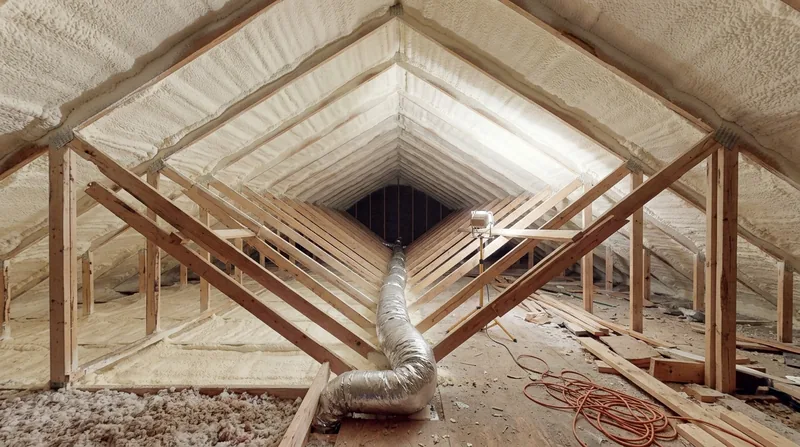




Attic spray foam insulation in St. Cloud stops the heat loss and air leakage that dominates energy waste in homes across central Minnesota. St. Cloud straddles the Mississippi River in Stearns and Benton County where winters drop below 25 degrees for weeks at a time, and attics that reach 130 degrees in July must then hold conditioned air through brutal cold. The traditional fiberglass batts and blown-in cellulose that fill most St. Cloud attics, from the early-1900s frame homes on the Southside near the university to the 1950s-70s ramblers on the East Side and the newer two-stories in Sartell and St. Joseph, all leak warm air through gaps, seams, and settling. Spray foam seals those leaks at the source, eliminates thermal bridging through framing, and stops the ice dams that form every winter when warm air melts snow on the roof. We help homeowners and builders across St. Cloud, Sauk Rapids, Waite Park, and surrounding areas understand which foam type and thickness makes sense for their attic, their budget, and their code requirements.
Why Attic Spray Foam Insulation Matters in St. Cloud's Extreme Climate
St. Cloud's climate creates two distinct failure modes in attics. In winter, warm interior air rises and leaks through gaps in the attic floor, framing, and rim board, carrying moisture that condenses on cold surfaces and feeds ice dams along the eaves. In summer, humid air pushes upward and outward, and any insulation that traps moisture without a proper vapor control layer will degrade and rot the framing beneath it. Traditional blown-in insulation settles over time, leaving voids along the rim, in corners, and around penetrations. Spray foam fills every cavity in a single pass and creates a continuous air barrier that stops the leak itself, not just slows it.
- We seal rim board and band joist cavities where air leaks are most severe and frost can accumulate inside basement walls.
- We control the moisture layer with closed-cell foam in high-vapor-drive zones and open-cell foam in areas where vapor can move safely to the interior.
- We apply foam to the roof deck of sealed attics, which keeps the attic at a similar temperature to the living space and eliminates ice dam formation.
- We remove failed fiberglass and old insulation before applying new foam, so there is no mold risk or settling underneath the new thermal envelope.
The result is a stable, durable attic that does not lose conditioned air and does not trap moisture that rots framing or feeds mold.
Key info: St. Cloud attics experience temperature swings of 155 degrees or more from summer peak to winter low. Fiberglass does not move with that expansion and contraction, but spray foam bonds to framing and moves as a single unit, preventing gaps from opening around insulation edges.
For more detail on the difference between foam types, see our guide to closed-cell spray foam insulation and open-cell spray foam insulation.
Minnesota's State Energy Code requires attic insulation to meet an R-value that depends on your zip code and the year your home was built. St. Cloud falls in Climate Zone 7, which calls for R-49 minimum in attics for new construction. Existing homes are not required to retrofit, but the building official at your city will tell you what applies if you are doing other work that triggers an energy code review. We help you understand what your local inspector needs to see, and we provide written estimates that specify R-value and foam thickness so there is no confusion when the inspector visits.
How We Install Attic Spray Foam Insulation in St. Cloud
Attic spray foam installation starts with a site visit and a careful assessment of the existing insulation, ventilation, and any moisture or contamination already present. We photograph the attic, measure the square footage, and note the height and slope of the roof, the condition of the rim board, and any penetrations for plumbing, electrical, or HVAC that need to be sealed. We then provide a written estimate with the R-value and thickness we recommend, the foam type (closed-cell or open-cell), the cost per square foot, and the total job price. Once you approve, we schedule the work and handle the permitting process by helping you navigate what your city requires.
- We set up mechanical ventilation to manage off-gassing during the cure period and control air quality throughout the job.
- We apply foam in controlled passes, monitoring drum temperature and spray ratio to ensure the foam expands and cures correctly without voids or thin spots.
- We seal all rim board cavities, band joists, and gaps around framing and penetrations so the attic becomes a true thermal envelope.
- We maintain a re-entry window of 24 to 48 hours and provide written guidance on when the space is safe to re-occupy and how to dispose of old insulation.
- We work year-round in St. Cloud, including through winter, because basement and rim work can be done indoors regardless of outdoor temperature.
The entire process, from estimate to final inspection, typically takes one to three weeks depending on permit timing and job complexity.
Example: A 1960s rambler in Waite Park with 1,200 square feet of attic space, original fiberglass batts, and a leaking rim board receives closed-cell foam at 3.5 inches (R-21) on the rim and band joist, then open-cell foam at 5.5 inches (R-21) over the attic floor. The closed-cell layer stops moisture and air leakage at the rim; the open-cell layer provides the bulk insulation and allows vapor to move safely to the interior. Total cost typically ranges from $2,400 to $3,200 depending on access, existing insulation removal, and local labor costs.
For more on how we handle insulation removal and replacement, see our insulation removal service page.
| Approach | Description | Best for |
|---|---|---|
| Closed-Cell Spray Foam | High-density foam (3.5 to 4 pounds per cubic foot) with an R-value of R-6 to R-6.5 per inch. Creates a vapor barrier and air seal in a single layer. Thinner than open-cell for the same R-value. | Rim board, band joist, and sealed attic roof decks where moisture control and air sealing are critical. Also used in metal buildings and barndominiums where condensation is the primary failure mode. |
| Open-Cell Spray Foam | Low-density foam (0.5 to 1.5 pounds per cubic foot) with an R-value of R-3.5 to R-3.8 per inch. Allows vapor to move through the foam, so it does not trap moisture. Softer and easier to cut around obstacles. | Attic floors in homes with good interior vapor control, sound-dampening applications, and retrofit jobs where existing ventilation must remain active. Lower cost per square foot than closed-cell. |
| Hybrid Approach | Closed-cell foam on the rim and band joist (the high-risk zone), then open-cell foam over the attic floor. Combines moisture control where it is needed most with cost savings on the bulk insulation. | Most St. Cloud homes. The rim is the primary air leak and ice dam source; the attic floor can be open-cell if vapor drive is managed. Balances performance and budget. |
| Attic Roof Deck Seal | Closed-cell foam applied directly to the underside of the roof sheathing to create a sealed, conditioned attic. The attic air temperature stays close to the home interior, eliminating ice dams and condensation on roof framing. | High-end retrofit or new construction where the attic will be used for storage or mechanical equipment. Requires careful attention to ventilation and moisture management. Higher cost but solves ice dam problems permanently. |
Attic Spray Foam Insulation Cost in St. Cloud: What to Expect
Attic spray foam insulation in St. Cloud typically starts at $1.50 to $2.50 per square foot for open-cell foam over the attic floor, and $2.50 to $4.00 per square foot for closed-cell foam on the rim board and band joist. A typical 1,200-square-foot attic with a hybrid approach (closed-cell rim and open-cell floor) runs between $2,400 and $3,600 before permits and inspections. The actual cost depends on several factors that we assess during the on-site estimate.
- Existing insulation removal adds cost if the attic contains fiberglass, cellulose, or failed foam that must be hauled away. Removal typically adds $0.25 to $0.50 per square foot.
- Attic access and working height matter. A steep roof or tight framing takes longer and costs more than a low-pitch roof with open rafter bays.
- Moisture or contamination in the attic (old rodent nests, mold, water stains) must be addressed before foam is applied. We walk away from wet substrates and do not spray over contamination.
- Foam thickness and R-value target drive the total. R-21 to R-38 is typical for St. Cloud attics; R-49 is required for new construction. Thicker foam costs proportionally more.
- Permit and inspection fees vary by city. St. Cloud, Sauk Rapids, Sartell, and Waite Park all have different requirements and timelines.
We provide a written estimate with the R-value, thickness in inches, foam type, and total cost. There are no hidden fees or surprise charges once you approve the estimate. We recommend getting two or three estimates from different contractors so you can compare not just price but also the foam type recommended, the R-value specified, and the contractor's approach to ventilation and moisture control.
For a detailed pricing breakdown and examples for different attic sizes and foam types, visit our pricing page.
What to Look for When Hiring an Attic Spray Foam Insulation Contractor Near St. Cloud
Not all spray foam contractors are equal. The trade includes rig-and-run crews that travel from out of state, spray a job in an afternoon with no ventilation or oversight, and disappear when the smell will not go away. It also includes national franchises that send crews with minimal local knowledge and no accountability if something goes wrong. The local independent contractor with a St. Cloud address, local plates, and a reputation to protect is positioned differently. When you are evaluating any contractor, including us, look for these markers of competence and integrity.
- Ask for a written estimate that specifies the foam type (closed-cell or open-cell), the R-value, the thickness in inches, and the total square footage. If an estimate has no R-value and no thickness, it is not an estimate; it is a sales pitch.
- Verify that the contractor is fully insured and ask to see the certificate of insurance. Call the insurance company to confirm the policy is active and covers spray foam work at the address you provide.
- Check references from at least two recent jobs in St. Cloud or nearby. Ask the homeowner about the quality of the work, the professionalism of the crew, the time it took, and whether there were any issues after the job was complete.
- Ask about the contractor's approach to ventilation during cure and the re-entry timeline. Any contractor who promises immediate re-entry or no smell is not being honest. Spray foam off-gasses for 24 to 48 hours, and mechanical ventilation is not optional.
- Confirm what permits are required at your address by calling your city building department. Ask the contractor to explain how they will handle permitting. Some cities require a permit for attic work; others do not. Your contractor should know the rules for your city.
- For homes in a homeowners association or a historic district, check the HOA rules or the city's historic preservation guidelines. Spray foam work inside the attic is rarely restricted, but exterior work on metal buildings or rim board may require approval.
A contractor who walks you through these steps, answers your questions directly, and is willing to put everything in writing is one you can trust. For a free, no-obligation estimate and a conversation with a local spray foam specialist, contact us at (320) 433-8205.
Attic Spray Foam Insulation in St. Cloud: Pricing Guide
| Service | Price | Details |
|---|---|---|
| Open-Cell Attic Floor Insulation | Starting at $1.50/sq ft | Bulk attic floor insulation at R-3.5 to R-3.8 per inch. Cost varies with attic size, access difficulty, and whether existing insulation removal is needed. |
| Closed-Cell Rim & Band Joist Seal | Starting at $2.50/sq ft | High-density foam for rim board and band joist cavities. Includes moisture barrier and air seal. Smaller square footage but critical for ice dam prevention in St. Cloud. |
| Hybrid Approach (Closed-Cell Rim + Open-Cell Floor) | Starting at $2.00/sq ft average | Closed-cell on rim and band joist for moisture control, open-cell over attic floor for bulk insulation. Most cost-effective performance option for St. Cloud attics. |
| Insulation Removal & Replacement | Starting at $0.50/sq ft removal plus foam cost | Removal of failed fiberglass, cellulose, or old foam before new spray foam application. Protects against mold and ensures clean substrate for new insulation bond. |
| Sealed Attic Roof Deck (Full Conditioned Attic) | On estimate | Closed-cell foam applied to roof sheathing underside. Requires detailed site assessment, ventilation planning, and code review. Price depends on total square footage and roof complexity. |
| Estimate & Site Visit | Free | No obligation. We assess existing insulation, measure square footage, identify moisture or contamination, and provide written estimate with R-value and thickness within 24 hours. |
Indicative pricing, the exact cost depends on square footage, finish, and site access. Free personalized estimate within 24h at (320) 433-8205.


