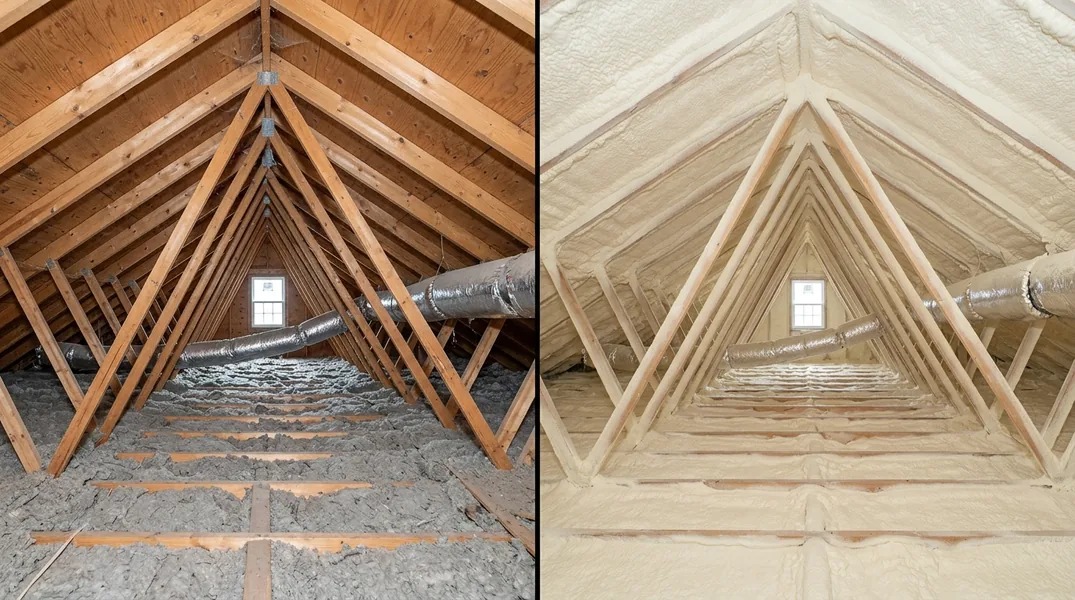
Understanding Minnesota's R-Value Requirements for Spray Foam Insulation
Minnesota's climate demands serious insulation performance, and the state's energy codes reflect that reality. If you're a homeowner in St. Cloud, you're living in one of the coldest regions in the continental United States, which means your attic insulation isn't optional, it's essential for comfort, safety, and energy efficiency.
The Minnesota State Energy Code requires different R-value minimums depending on your building's age and the specific area being insulated. For new construction and major renovations, attic insulation typically needs to meet R-38 to R-49 standards, while basement walls and crawl spaces have their own specifications. The reason these numbers matter is that they directly impact your heating costs, which can account for 40 to 50 percent of your home's total energy consumption during Minnesota winters.
Attic Spray Foam Insulation offers distinct advantages when it comes to meeting and exceeding these code requirements. Unlike traditional fiberglass batts or blown cellulose, spray foam creates an air-sealed barrier that prevents heat loss through gaps, cracks, and penetrations. This air-sealing capability means you're not just meeting the R-value requirement, you're also eliminating the thermal bridging and air leakage that reduce the effective performance of conventional insulation.
Spray Foam Insulation R-Value Per Inch: What You Need to Know
When evaluating spray foam options, understanding the relationship between thickness and R-value is crucial. The spray foam insulation r value per inch varies significantly between two main types: closed-cell and open-cell formulations. Closed Cell Spray Foam Insulation delivers approximately 6.0 to 6.5 R-value per inch, making it the superior choice for maximum insulation performance in minimal space. This density and performance make it ideal for attics where space is limited or where you need to achieve high R-values without excessive thickness.
In contrast, Open Cell Spray Foam Insulation provides approximately 3.5 to 3.6 R-value per inch. While this is lower per inch, open-cell foam is more cost-effective and still delivers excellent air-sealing properties. For a homeowner in St. Cloud deciding between the two, the choice often comes down to budget, available space, and specific performance goals.
To meet Minnesota's R-38 requirement in an attic, you would need approximately 6 inches of closed-cell foam or 10 to 11 inches of open-cell foam. The thicker open-cell application isn't a disadvantage if space permits, but closed-cell's superior performance per inch makes it the preferred choice when attic height is constrained or when you're retrofitting an existing home where space is limited.
How Thick Should Spray Foam Be? Meeting Code in Minnesota Attics
Determining how thick should spray foam be in your attic requires balancing Minnesota's energy code requirements with your specific home's characteristics. The answer isn't one-size-fits-all because factors like existing insulation, attic ventilation design, and your home's age all influence the final thickness recommendation.
For most new construction projects in Minnesota, closed-cell spray foam at 6 to 7 inches achieves the R-38 to R-49 range required by state code. If you're upgrading an older home with minimal existing insulation, you might apply closed-cell foam directly to the underside of the roof deck to create an unvented attic assembly, which is highly effective in Minnesota's climate. This approach prevents moisture issues that can occur with vented attics in cold climates and provides superior air sealing compared to traditional vented attic designs.
Open-cell foam applications typically run 10 to 12 inches to achieve equivalent R-values, but they require proper ventilation and vapor management. Your St Cloud Spray Foam Insulation professional should evaluate your specific attic conditions, including roof pitch, existing insulation, ventilation requirements, and moisture dynamics before recommending a final thickness. Undersizing your insulation means failing to meet code and losing energy savings; oversizing wastes money without proportional performance gains. The sweet spot is determined through a professional assessment that considers both energy code compliance and long-term durability.
Federal Insulation Tax Credit: What Changed for 2026
For several years, the federal Energy Efficient Home Improvement Credit (section 25C) let homeowners claim part of the cost of qualifying insulation. That credit ended for improvements placed in service after December 31, 2025, so Attic Spray Foam Insulation and other insulation work completed in 2026 no longer qualifies for it. Older articles and contractor flyers still mention it, which is why it is worth checking the date on any incentive you read about.
Tax rules change, and your own situation matters, so ask a tax professional before you count on any tax benefit for a home project. What has not changed is the reason to insulate: in a heating-dominated climate like St. Cloud, a well air-sealed, properly insulated attic keeps more of the heat you pay for inside the house.
Utility Rebates and Local Energy Programs in St. Cloud
Many utility companies and local energy programs offer insulation rebates that can reduce your out-of-pocket costs. If your home is served by Xcel Energy or a local cooperative, you may qualify for rebates on insulation upgrades that improve your home's energy performance. Programs, amounts and eligibility rules change from year to year, so check the current terms directly with your utility.
St. Cloud and surrounding communities often have energy efficiency programs administered through local government or utility partnerships. Some programs provide rebates specifically for attic insulation upgrades, while others offer broader home energy improvement incentives. The key is to research your specific utility provider's current offerings and understand the application process before you begin your project. Some rebates require pre-approval, meaning you need to apply and receive authorization before installation begins. Others are claimed after completion with proof of purchase and installation documentation.
When you reach out to St Cloud Spray Foam Insulation at (320) 433-8205, we can give you the written details of the work (foam type, thickness, R-value) that a utility rebate application usually asks for.
Attic Spray Foam Insulation Cost in St. Cloud: What to Budget
Understanding the investment required for spray foam insulation helps you make an informed decision and plan your budget effectively. The spray foam insulation r value per inch performance directly influences cost, as does the type of foam you select. Closed-cell spray foam typically costs more per square foot than open-cell, but remember that you need less thickness to achieve the same R-value, which can offset the higher per-unit cost.
In St. Cloud, typical attic spray foam projects range from $1,500 to $5,000 or more, depending on attic size, existing insulation conditions, and whether you choose closed-cell or open-cell foam. A 1,200 square foot attic with minimal existing insulation might run $2,000 to $3,500 for closed-cell foam, while the same project with open-cell could cost $1,500 to $2,500. These are ballpark figures, and your actual pricing depends on your home's unique characteristics. Factors like roof access difficulty, the need for existing insulation removal, and local labor rates all influence final costs.
The most important step is obtaining quotes from qualified local contractors. When you request a free estimate from St Cloud Spray Foam Insulation, you'll receive a detailed breakdown of materials, labor, and timeline. This allows you to compare options, and make a decision based on complete information. Remember that the cheapest option isn't always the best value, especially with insulation. Quality installation and proper thickness matter far more than saving a few hundred dollars on a project that will impact your home's comfort and efficiency for decades.
Looking for a professional spray foam insulation contractor in St. Cloud? St Cloud Spray Foam Insulation responds fast for all your spray foam insulation needs.
Get a Free Quote