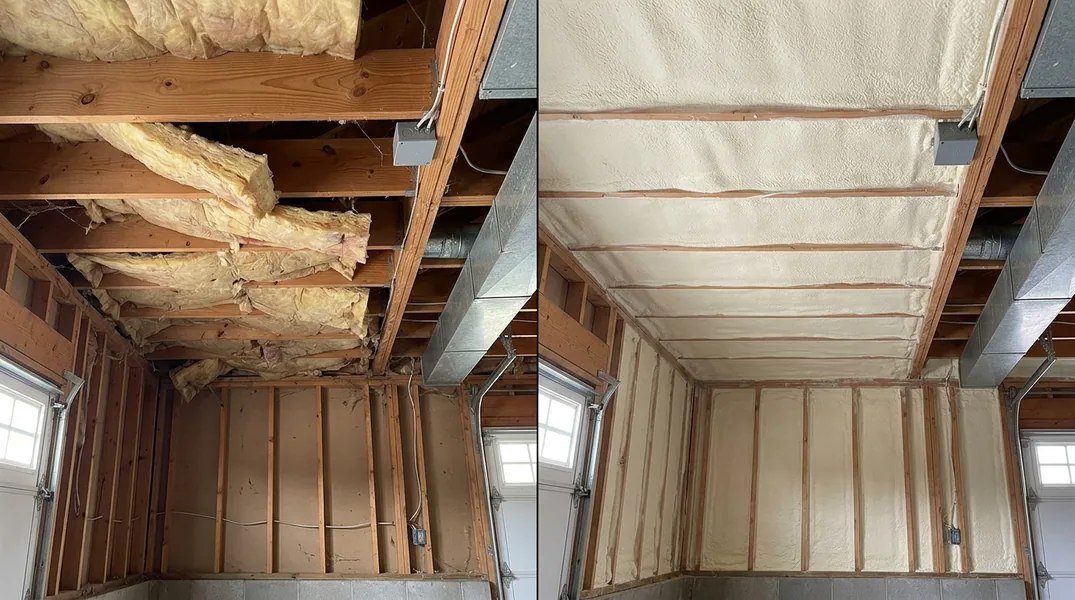
Understanding Spray Foam Insulation Basics
When homeowners in St. Cloud decide to upgrade their attic insulation, spray foam has become one of the most popular choices. But before you commit to any project, it's important to understand what spray foam actually is and why it's different from traditional fiberglass or cellulose insulation.
Spray foam insulation is applied as a liquid that expands and hardens into a solid foam. This expansion allows it to fill gaps, cracks, and irregular spaces that would be difficult or impossible to seal with traditional batts or blown-in materials. The result is a more complete thermal and air barrier, which translates to better energy efficiency and comfort in your home. However, not all spray foam is created equal. The two primary types, open-cell and closed-cell, have distinct characteristics that make each suitable for different applications and budgets.
What is Open Cell Spray Foam and How Does It Work
Open Cell Spray Foam Insulation is a lighter, more flexible material that contains cells that are not completely closed. Think of it like a sponge with tiny air pockets that are open to one another. This structure makes open-cell foam softer and easier to cut or trim after installation, which can be helpful during the application process. The material is also more permeable to air and moisture vapor, which has both advantages and disadvantages depending on your specific situation.
One of the primary benefits of open-cell foam is its cost effectiveness. It typically costs less per board foot than closed-cell alternatives, making it an attractive option for budget-conscious homeowners. Open-cell spray foam also provides excellent sound dampening properties, which can be a nice bonus if you're concerned about noise transmission between rooms or from outside. However, because it's more permeable, open-cell foam does not provide a vapor barrier and should not be used in applications where moisture control is critical, such as crawl spaces or below-grade walls.
What is Closed Cell Spray Foam and Its Advantages
Closed Cell Spray Foam Insulation is a denser, more rigid material where the cells are completely sealed. This creates a much tighter barrier against both air and moisture. Because of its density and impermeability, closed-cell foam is the superior choice for areas where moisture resistance is essential, such as basements, crawl spaces, or exterior walls that may be exposed to wind-driven rain.
The structural strength of closed-cell foam is another significant advantage. It adds rigidity to walls and roofs, which can actually improve the structural integrity of your home. This is particularly valuable in areas prone to severe weather. Additionally, closed-cell foam provides a built-in vapor barrier, eliminating the need for a separate vapor barrier installation. While closed-cell foam does cost more upfront than open-cell alternatives, many homeowners find the investment worthwhile due to its superior performance and durability.
Closed Cell Spray Foam R Value vs Open Cell: The Numbers That Matter
When comparing insulation materials, the R-value is the metric that matters most. This number measures thermal resistance, with higher values indicating better insulation performance. Understanding the closed cell spray foam R value compared to open-cell options is crucial for making an informed decision about your Attic Spray Foam Insulation project.
Open-cell spray foam typically delivers an R-value of approximately 3.5 to 3.6 per inch of thickness. This means that if you apply a 5-inch layer of open-cell foam, you'll achieve an R-value of around R-17.5 to R-18. Closed-cell foam, by contrast, offers a much higher R-value of 6.0 to 7.0 per inch, depending on the specific product formulation. A 5-inch application of closed-cell foam would yield an R-value of R-30 to R-35. This significant difference means that to achieve equivalent insulation performance with open-cell foam, you would need to apply it at roughly double the thickness, which substantially increases material and labor costs and may not be practical in many attic spaces with limited height.
For homeowners in St. Cloud, where winters are cold and heating costs can be substantial, the superior R-value of closed-cell foam often makes economic sense despite the higher initial cost. The energy savings over time can offset the premium price, particularly if you plan to stay in your home for many years.
Attic Spray Foam Insulation Cost in St. Cloud: What to Budget
Understanding the financial investment required for spray foam insulation is essential for homeowners planning a retrofit or new construction project. The cost of spray foam insulation varies based on several factors, including the type of foam, the thickness required, the accessibility of the space, and local market conditions. Generally speaking, open-cell spray foam is the more affordable option, typically ranging from $1.00 to $1.50 per board foot installed, while closed-cell foam usually costs between $1.50 and $2.50 per board foot or more.
For a typical attic application in a St. Cloud home, these numbers can add up quickly. A 1,000 square foot attic with 5 inches of open-cell foam might cost between $5,000 and $7,500, while the same space with closed-cell foam could range from $7,500 to $12,500 or higher. However, these are rough estimates, and actual costs depend on your specific situation. The best way to understand your actual investment is to request a free estimate from St Cloud Spray Foam Insulation. Our team can evaluate your attic, discuss your goals, and provide transparent pricing based on your exact needs. Call us at (320) 433-8205 to schedule your consultation.
Which Type Should You Choose for Your St. Cloud Home
Deciding between open-cell and closed-cell spray foam ultimately depends on your specific application, budget, and long-term goals. For attic insulation in a typical St. Cloud residence, open-cell foam can be an excellent choice if your primary concern is cost and you're not worried about moisture issues. Attics are generally dry environments, making open-cell foam's permeability less problematic. The sound dampening benefits are also a nice bonus if you have living space above your attic or if noise reduction is a priority.
Closed-cell foam is the better choice if you need superior insulation performance in a compact space, if you're insulating below-grade areas like basements or crawl spaces, or if you're applying Wall & Injection Foam Insulation to exterior walls. The moisture resistance, structural benefits, and higher R-value per inch make closed-cell foam the premium option that delivers maximum performance and protection.
The most important step is to consult with experienced professionals who understand your local climate and building conditions. St Cloud Spray Foam Insulation has been serving homeowners throughout the region, and our team can assess your specific situation and recommend the right solution. Contact us today at (320) 433-8205 or visit our website to learn more about how we can help improve your home's energy efficiency and comfort.
Looking for a professional spray foam insulation contractor in St. Cloud? St Cloud Spray Foam Insulation responds fast for all your spray foam insulation needs.
Get a Free Quote